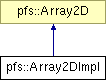
#include <array2d.h>
Public Member Functions | |
| Array2DImpl (int cols, int rows) | |
| ~Array2DImpl () | |
| int | getCols () const |
| Get number of columns or, in case of an image, width. | |
| int | getRows () const |
| Get number of rows or, in case of an image, height. | |
| float & | operator() (int col, int row) |
| Access an element of the array for reading and writing. | |
| const float & | operator() (int col, int row) const |
| Access an element of the array for reading. | |
| float & | operator() (int index) |
| Access an element of the array for reading and writing. | |
| const float & | operator() (int index) const |
| Access an element of the array for reading. | |
| float * | getRawData () |
Definition at line 152 of file array2d.h.
| float& pfs::Array2DImpl::operator() | ( | int | col, | |
| int | row | |||
| ) | [inline, virtual] |
Access an element of the array for reading and writing.
Whether the given row and column are checked against array bounds depends on an implementing class.
Note, that if an Array2D object is passed as a pointer (what is usually the case), to access its elements, you have to use somewhat strange syntax: (*array)(row, column).
| col | number of a column (x) within the range 0..(getCols()-1) | |
| row | number of a row (y) within the range 0..(getRows()-1) |
Implements pfs::Array2D.
| const float& pfs::Array2DImpl::operator() | ( | int | col, | |
| int | row | |||
| ) | const [inline, virtual] |
Access an element of the array for reading.
Whether the given row and column are checked against array bounds depends on an implementing class.
Note, that if an Array2D object is passed as a pointer (what is usually the case), to access its elements, you have to use somewhat strange syntax: (*array)(row, column).
| col | number of a column (x) within the range 0..(getCols()-1) | |
| row | number of a row (y) within the range 0..(getRows()-1) |
Implements pfs::Array2D.
| float& pfs::Array2DImpl::operator() | ( | int | index | ) | [inline, virtual] |
Access an element of the array for reading and writing.
This is probably faster way of accessing elements than operator(col, row). However there is no guarantee on the order of elements as it usually depends on an implementing class. The only assumption that can be make is that there are exactly columns*rows elements and they are all unique.
Whether the given index is checked against array bounds depends on an implementing class.
Note, that if an Array2D object is passed as a pointer (what is usually the case), to access its elements, you have to use somewhat strange syntax: (*array)(index).
| index | index of an element within the range 0..(getCols()*getRows()-1) |
Implements pfs::Array2D.
| const float& pfs::Array2DImpl::operator() | ( | int | index | ) | const [inline, virtual] |
Access an element of the array for reading.
This is probably faster way of accessing elements than operator(col, row). However there is no guarantee on the order of elements as it usually depends on an implementing class. The only assumption that can be make is that there are exactly columns*rows elements and they are all unique.
Whether the given index is checked against array bounds depends on an implementing class.
Note, that if an Array2D object is passed as a pointer (what is usually the case), to access its elements, you have to use somewhat strange syntax: (*array)(index).
| index | index of an element within the range 0..(getCols()*getRows()-1) |
Implements pfs::Array2D.
 1.5.3
1.5.3